
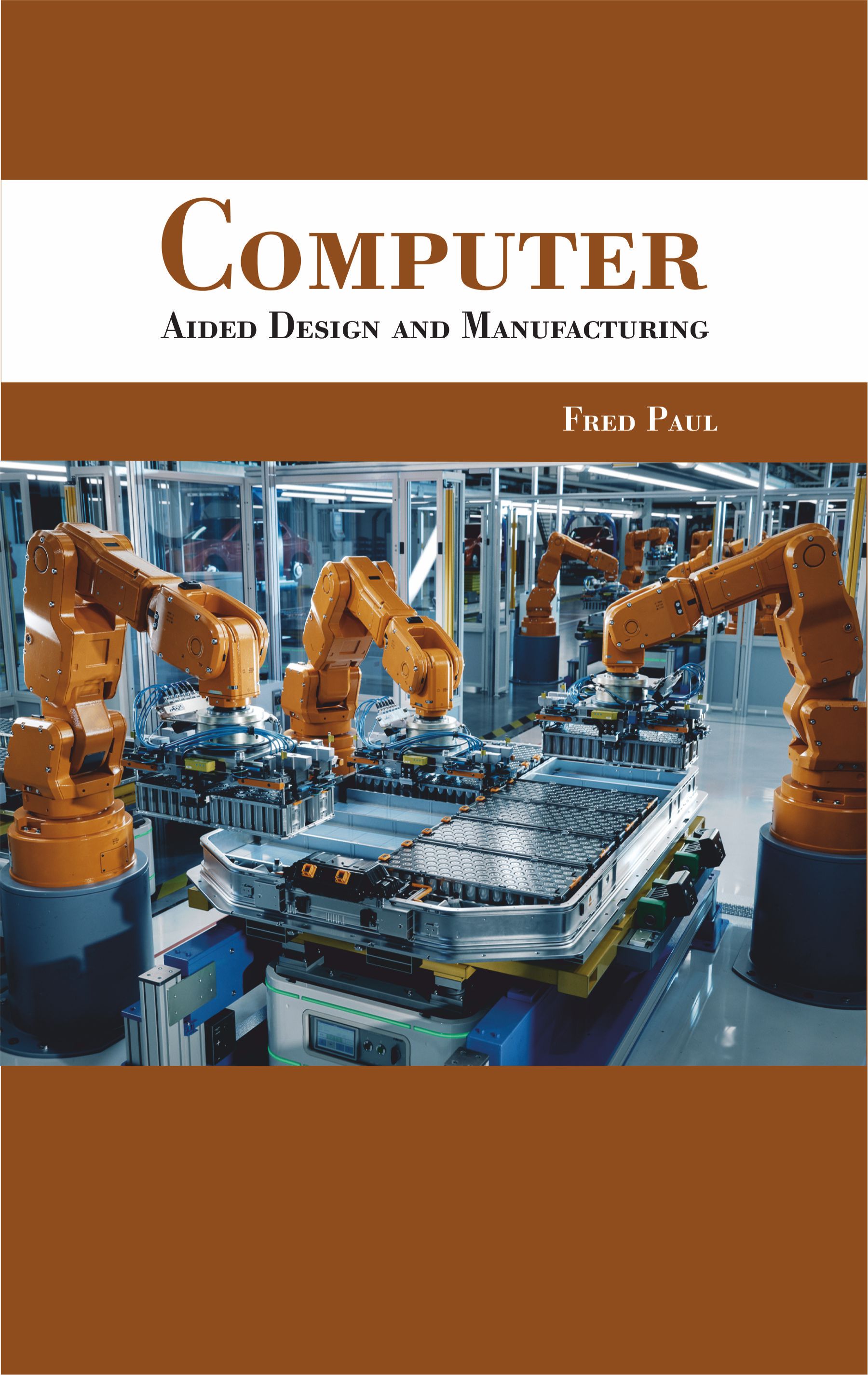
The book on Computer-Aided Design and Manufacturing provides a comprehensive exploration of the principles, technologies, and applications that define the integration of digital tools in the design and production of goods. It serves as an essential guide for students, engineers, and professionals involved in the fields of mechanical engineering, industrial design, architecture, electronics, and manufacturing. The text introduces readers to the foundational concepts of CAD, detailing how digital systems are used to create precise 2D drawings and complex 3D models that streamline the design process. It also elaborates on the role of CAM, explaining how computer systems translate design data into instructions for machines used in fabrication and assembly processes. The book highlights the historical evolution of CAD/CAM technologies and underscores their growing significance in modern industry. Through well-structured chapters, the book covers topics such as geometry creation, modelling techniques, simulation, tool path generation, process planning, and the integration of CAD and CAM systems. It discusses how the synergy between design and manufacturing has revolutionized industries by reducing time-to-market, improving product quality, and enhancing design flexibility. Emphasis is placed on the importance of accuracy, efficiency, and collaboration, as well as the economic and environmental advantages brought by digital transformation in manufacturing workflows. Special sections may also touch upon advanced topics such as CNC programming, additive manufacturing, digital twins, and the use of artificial intelligence in optimizing CAD/CAM operations. In addition to technical explanations, the book presents real-world examples, case studies, and illustrations that provide practical insights into how CAD/CAM systems are applied in various industrial settings. The text encourages critical thinking by discussing challenges and innovations in the field, and it often includes exercises or problems to reinforce learning.
Fred Paul is a distinguished expert in the field of Computer-Aided Design and Manufacturing (CAD/CAM), recognized for his extensive contributions to the advancement of digital technologies in engineering and industrial production. With a background in mechanical engineering and decades of hands-on experience in both academic and industrial environments, Fred Paul has become a respected authority in integrating design innovation with automated manufacturing systems. Throughout his career, Fred Paul has been actively involved in the development, implementation, and teaching of CAD/CAM systems. He has worked with leading engineering firms, where he contributed to the design and optimization of complex manufacturing processes, ensuring precision, efficiency, and scalability. His deep understanding of computer integrated manufacturing, CNC machining, and product life cycle management has been instrumental in bridging the gap between theoretical design and practical application. As an educator, Fred Paul has taught courses on CAD, CAM, and digital manufacturing at reputed engineering institutions. He is known for his ability to simplify complex concepts and convey them in a clear, engaging manner. His research work has been widely published in journals and presented at international conferences, covering topics such as CAD modeling techniques, toolpath optimization, and the future of intelligent manufacturing. Fred Paul's expertise extends to emerging technologies, including additive manufacturing, generative design, and smart factory systems, where he continues to explore how innovation can shape the next generation of industrial design and production. Through his books, lectures, and consultancy work, he remains committed to advancing the field and inspiring the next wave of engineers and designers to harness the full potential of computer-aided technologies.
Preface Chapter 1. Smart Manufacturing: Computer-Driven Industrial Processes Chapter 2. Foundations of CAD: Theory and Applications Chapter 3. Memory: ROM and RAM Chapter 4. Computer-Aided Technologies in Modern CAD/CAM Systems Chapter 5. Hardware Architecture for CAD Systems Chapter 6. Parallelism and Acceleration in Modern CAD Computing Chapter 7. Software Architecture for CAD Systems Chapter 8. Backbone of Parametric Design Systems: Software Modules Bibliography Index

$280.00