
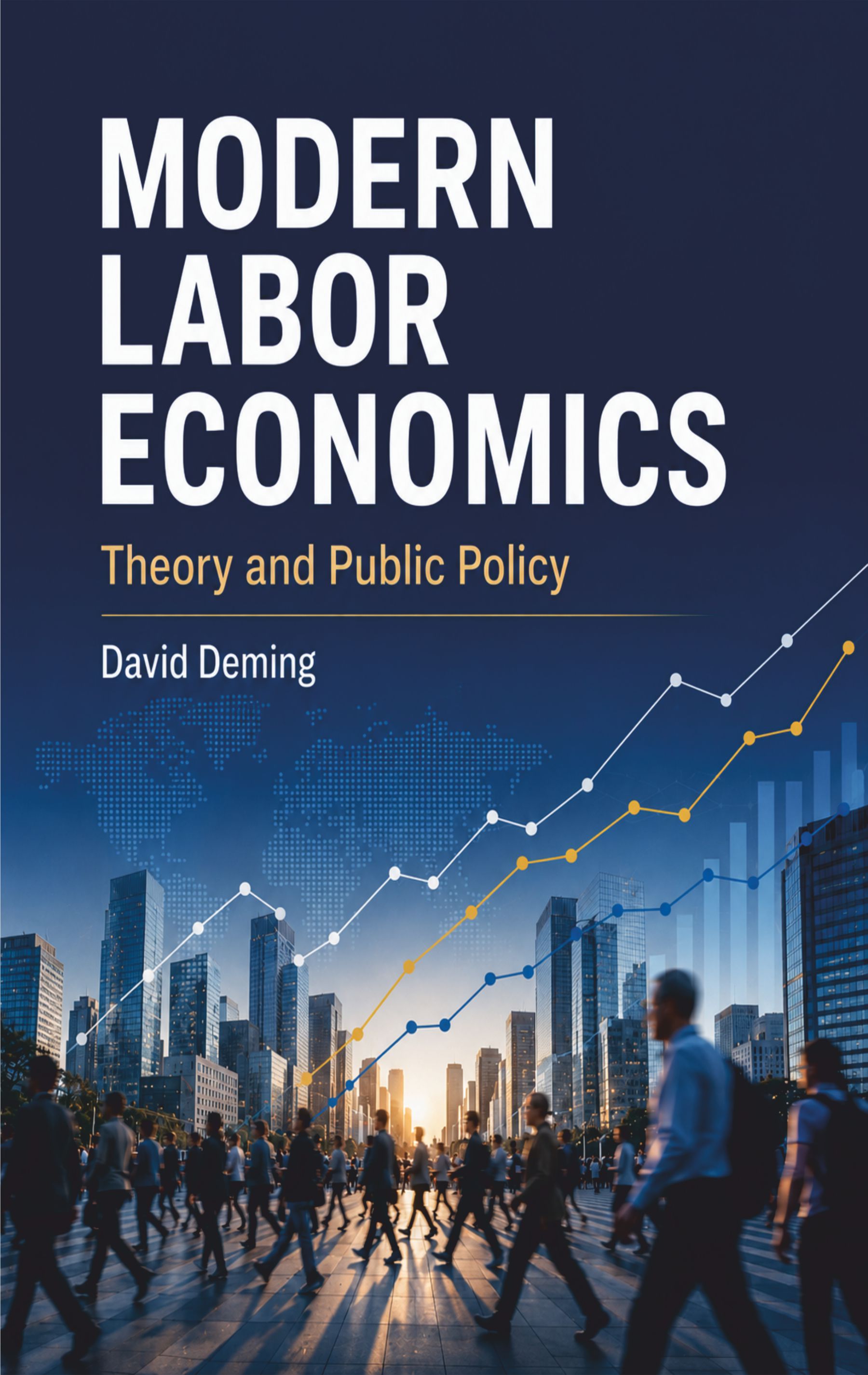
Labor economics has always been an "applied" branch of study, and a thorough grounding in the eld requires at least an acquaintance with basic methodological techniques and problems. Labor Economics is a eld of study that examines the behavior of individuals, rms, and markets in relation to the employment and compensation of labor. This book delves into the analysis of workforce trends, wage determination, labor market policies, and the impact of government interventions on employment. Students will explore theoretical frameworks and empirical methods to understand the dynamics of labor markets, addressing issues such as unemployment, discrimination, and the role of human capital in shaping economic outcomes. Labor economics analyzes the behavior of employers and employees, focusing on wage determination, employment levels, and human capital, while public policy intervenes to address market inefciencies, inequality, and unemployment. Key policy areas include minimum wage laws, tax-transfer systems, education, immigration, and labor regulations, often aiming to balance economic efciency with social equity. This book explores using microeconomic theory and econometric analysis and emphasizes the link between research and public policy. Topics include labor supply and labor demand, taxes and transfers, minimum wages, immigration, human capital, education production, inequality, discrimination, and labor unions.
David Deming is a Professor of Economics at Harvard University, a research associate at the National Bureau of Economic Research, and a former junior fellow in the Harvard Society of Fellows. He specializes in research involving applied microeconomics, applied economics, and labor economics. His research primarily focuses on education and discrimination. His work focuses specifically on the exploration of a variety of subjects, such as structural estimation, affirmative action, minimum wages, teen sex, discrimination, higher education, and dynamic discrete choice models, among others. Deming has published papers on topics such as the racial achievement gap, the causes and consequences of distinctively black names, affirmative action, the impact of the crack cocaine epidemic, historically black colleges and universities, and acting white. In January 2008, at the age of 30, he became the youngest American to receive tenure from Harvard. He has been awarded a Sloan Research Fellowship, a Faculty Early Career Development Award from the National Science Foundation, and the inaugural Alphonse Fletcher Award (Guggenheims for race issues). In addition to his teaching and research responsibilities, Deming served as the Chief Equality Officer at the New York City Department of Education during the 2007–2008 school year. In this role, he developed and implemented several innovative ideas on student motivation and teacher pay-for-performance concepts. He won a Titanium Lion at the Cannes Lions International Advertising Festival (Breakthrough Idea of the Year in 2008) for the Million Motivation Campaign.
| Preface 1. LABOR MARKET THEORIES IN CONTEMPORARY ECONOMICS 1.1 Neoclassical and Keynesian views on labor market functioning 1.2 Contemporary labor market theories 1.3 Summary 2. OVERVIEW OF THE LABOR MARKET 2.1 The Labor Market: Definitions, Facts, and Trends 2.2 How the Labor Market Works 2.3 Applications of the Theory 3. THE DEMAND FOR LABOR 3.1 Profit Maximization 3.2 The Short-Run Demand for Labor When Both Product and Labor Markets Are Competitive 3.3 The Demand for Labor in Competitive Markets When Other Inputs Can Be Varied 3.4 Labor Demand When the Product Market Is Not Competitive 3.5 Policy Application: The Labor Market Effects of Employer Payroll Taxes and Wage Subsidies 4. LABOR DEMAND ELASTICITIES 4.1 The Own-Wage Elasticity of Demand 4.2 The Cross-Wage Elasticity of Demand 4.3 Policy Application: Effects of Minimum Wage Laws 4.4 Applying Concepts of Labor Demand Elasticity to the Issue of Technological Change 5. FRICTIONS IN THE LABOR MARKET 5.1 Frictions on the Employee Side of the Market 5.2 Frictions on the Employer Side of the Market 5.3 Training Investments 5.4 Hiring Investments 6. SUPPLY OF LABOR TO THE ECONOMY: THE DECISION TO WORK 6.1 Trends in Labor Force Participation and Hours of Work 6.2 A Theory of the Decision to Work 6.3 Empirical Findings on the Income and Substitution Effects 6.4 Policy Applications |
|

$280.00