
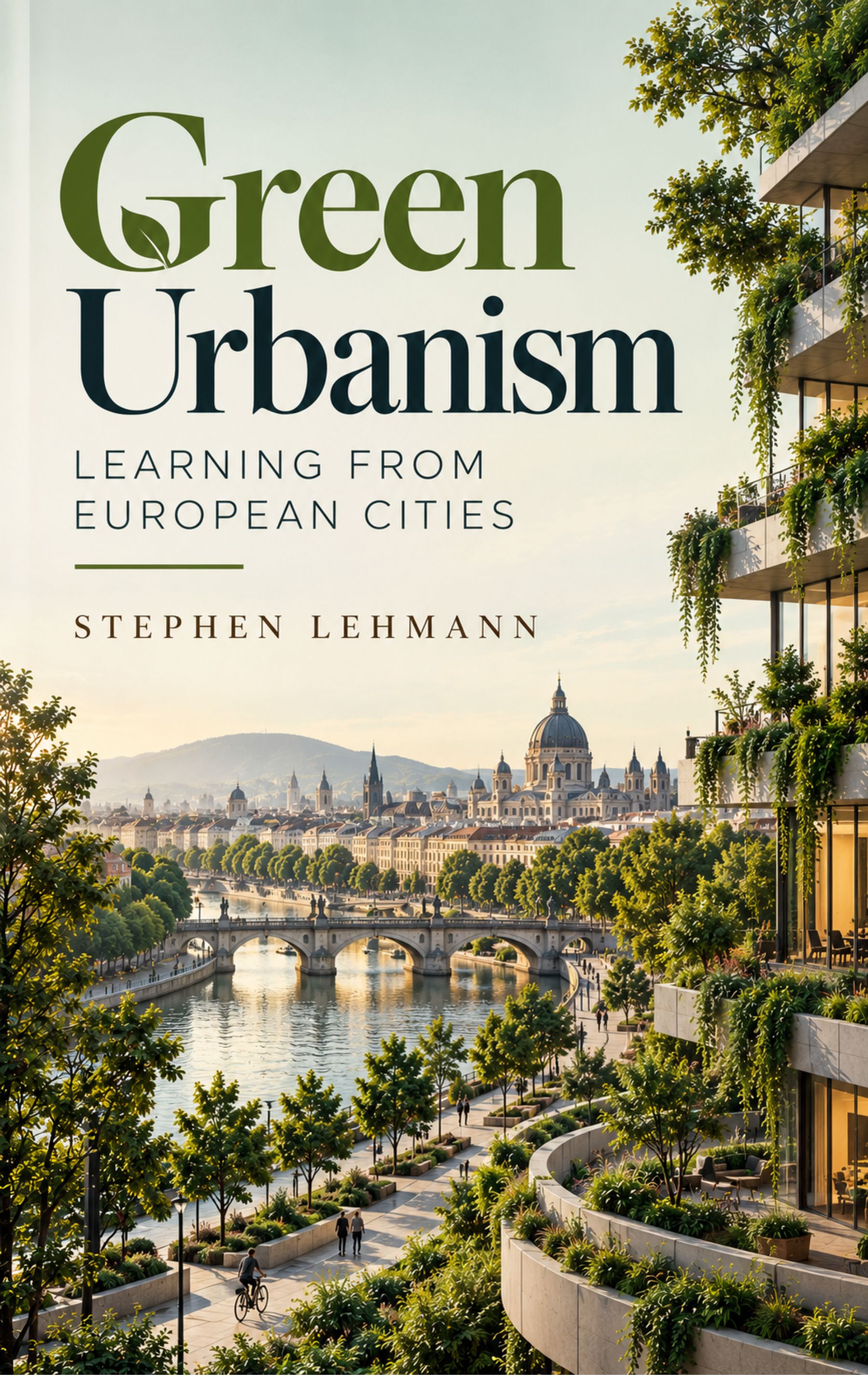
Green Urbanism: Learning From European Cities explores how planners and policymakers can draw on successful European sustainability models to reduce ecological footprints and create highly livable, environmentally sensitive communities. The book establishes the core philosophy that urban environments must shift from consumptive, sprawling models to restorative ones. It advocates for an ecological approach to urban design that respects local climate, minimizes carbon footprints, and integrates nature directly into human habitats. The text draws extensively on the policies of innovative cities across eleven European countries such as Copenhagen, Stockholm, Vienna, and Freiburg. These cities demonstrate how holistic environmental strategies lead to a higher quality of life and serve as transferable blueprints for urban areas globally. Highlighting the importance of compact urban cores, the text critiques urban sprawl. It focuses on the creation of "eco-cities" and transit-oriented development, promoting dense, mixed-use neighborhoods where daily needs are easily accessible, thereby preserving surrounding rural and natural landscapes. A major emphasis is placed on reducing reliance on private automobiles. The book explores how European cities successfully promote walking, cycling, and robust public transit networks through infrastructure investments, congestion pricing, and pedestrian-friendly street designs. rgy models.
Dr. Stephen Lehmann is a globally recognized scholar and leading advocate for sustainable urban design. Holding a Ph.D. in City and Regional Planning, he has spent his career exploring how cities can live in harmony with nature while drastically reducing their ecological footprints. Lehmann's fascination with regenerative design began during extensive, year-long research residencies across the Netherlands and broader Europe. By studying the architectural and ecological triumphs of 25 innovative European municipalities, he became convinced that modern metropolitan areas can function as circular, life-sustaining ecosystems. This eye-opening research laid the groundwork for his seminal work, Green Urbanism: Learning from European Cities. As a prominent professor, Lehmann actively bridges the gap between academic theory and practical, on-the-ground urban policy. He regularly advises civic leaders and regional planners on how to implement circular waste systems, eco-budgeting, and renewable energy transitions in their own communities. Driven by the belief that urban spaces can and should be restorative, his ongoing mission is to inspire greener, healthier, and more livable cities across the globe Dr. Stephen Lehmann's expertise spans the entire spectrum of modern ecological design. His pioneering academic and practical work directly explores the core pillars of urban sustainability tracing the historic and modern roots of eco-cities, and why European municipalities are prime blueprints for global replication; Integrating functional, car-free mobility, transit networks, and sustainable transport systems into urban fabrics; Designing restorative green infrastructure, circular waste management systems, and climate-resilient architecture; Empowering local governments and ensuring active citizen participation in the evolution of circular cities. His research focuses on turning abstract ecological concepts into actionable municipal policies. He draws extensively on best-practice case studies from leading sustainability laboratories like Copenhagen, Freiburg, and Amsterdam.
Preface Chapter 1. Foundations of Green Urbanism Defining Green Urbanism and Its Principles Historical Evolution of Sustainable Cities Global Context and the European Perspective Urban Ecology and Environmental Planning Interdisciplinary Approaches to Green Cities Measuring Sustainability in Urban Contexts Policy and Governance Frameworks Challenges and Opportunities in Green Urbanism Chapter 2. European Cities as Models of Sustainability Scandinavian Cities: Sustainability and Livability Dutch Approaches to Water and Urban Design German Eco-Cities and Green Infrastructure Swiss Urban Planning and Environmental Efficiency French Urban Green Policies and Practices Mediterranean Cities and Climate Adaptation Comparative Analysis of European Best Practices Lessons for Global Green Urbanism Chapter 3. Urban Planning for Green Cities Land Use Planning and Environmental Integration Compact City and Smart Growth Models Transit-Oriented Development and Walkability Mixed-Use Development and Urban Density Zoning and Regulatory Tools for Sustainability Green Urban Design Principles Retrofitting Existing Urban Areas Participatory Planning and Community Engagement Chapter 4. Mobility and Sustainable Transport Public Transport Systems and Urban Connectivity Cycling and Pedestrian Infrastructure Reducing Car Dependence and Traffic Congestion Integration of Multimodal Transport Systems Electric Mobility and Low-Emission Zones Urban Freight and Logistics Management Policies for Behavior Change in Transportation Case Studies from European Cities Chapter 5. Green Infrastructure and Urban Ecology Parks, Green Corridors, and Urban Forests Water-Sensitive Urban Design Urban Biodiversity and Habitat Conservation Roof Gardens, Vertical Greenery, and Green Walls Climate-Resilient Landscape Planning Stormwater Management and Sustainable Drainage Integrating Nature-Based Solutions in Cities Monitoring and Evaluating Urban Green Infrastructure Chapter 6. Energy, Buildings, and Sustainable Architecture Energy-Efficient Buildings and Retrofitting Passive Design and Low-Energy Construction Renewable Energy Integration in Urban Areas Eco-Districts and Carbon-Neutral Neighborhoods Green Certification and Sustainability Standards Adaptive Reuse of Historic Buildings Smart Buildings and Technology Integration Case Studies in European Green Architecture Chapter 7. Waste Management and Circular Cities Principles of Circular Economy in Urban Contexts Waste Reduction, Recycling, and Reuse Organic Waste and Urban Composting Programs Energy Recovery and Resource Efficiency Policies and Incentives for Sustainable Waste Management Community Participation and Behavioral Change Industrial Symbiosis and Urban Metabolism Lessons from European Circular Cities Chapter 8. Climate Change Adaptation and Resilience Urban Heat Island Effect and Mitigation Flood Management and Coastal Urban Planning Disaster-Resilient Infrastructure Green Urban Planning for Climate Adaptation Policy Frameworks and Ri

$280.00