
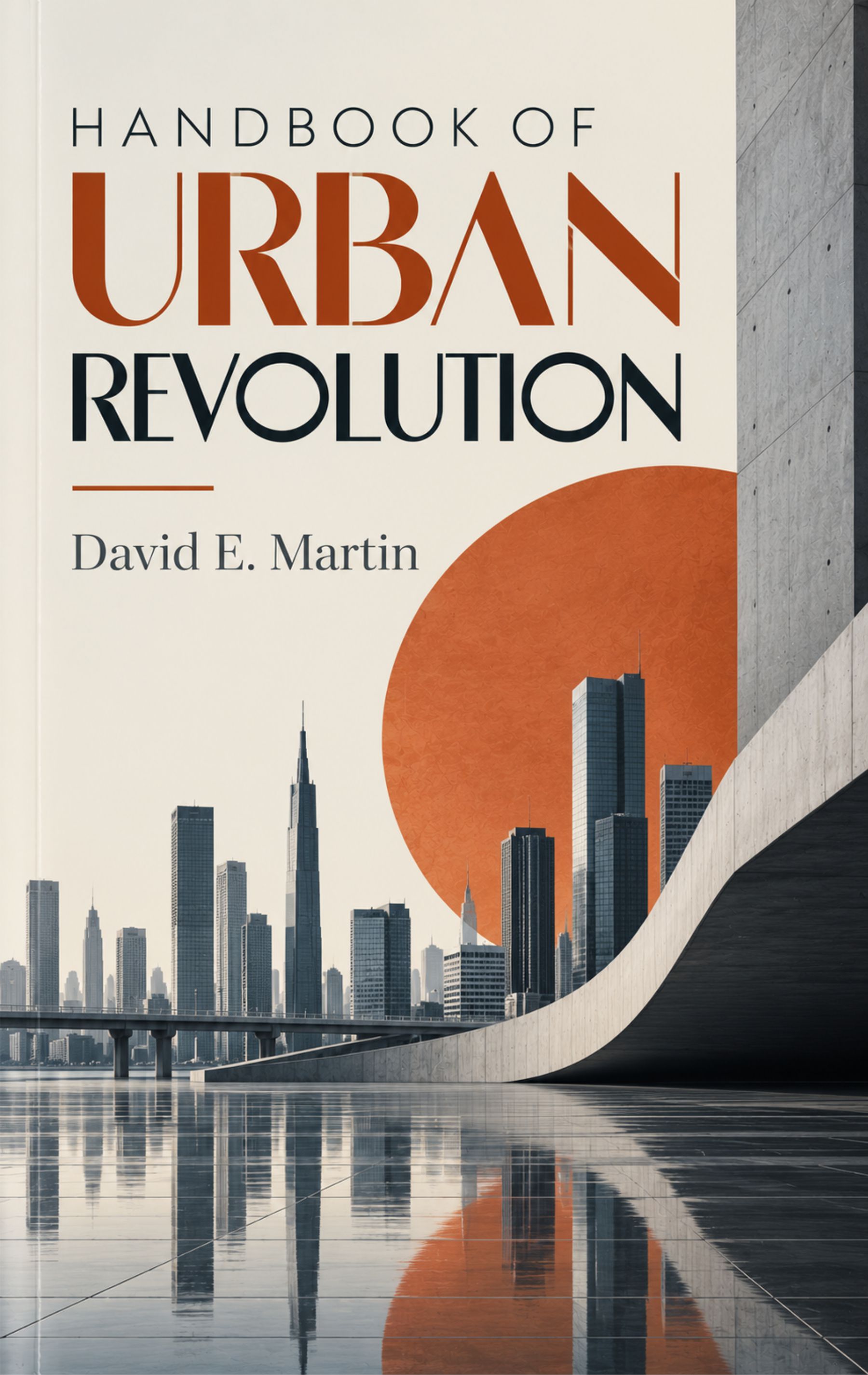
The Handbook of Urban Revolution provides a comprehensive analysis of modern urbanization, tracing the profound socio-political, economic, and ecological shifts shaping today's cities. It equips policymakers, urban planners, and scholars with actionable strategies to navigate the complexities of contemporary urban growth, spatial justice, and climate resilience. This book defines the foundational concepts of the urban revolution, exploring how human settlements are shifting from industrial hubs to globally interconnected urban societies. It explores the theoretical frameworks required to understand the modern city as a dynamic and ever-evolving ecosystem. A look at the historical evolution of cities, tracing the timeline from early agricultural civilizations. By reviewing the roots of urban development, this text establishes how past policies, migration patterns, and civic designs have continuously built upon and responded to societal needs. It identifies the primary forces propelling rapid urbanization today. This book explores how globalization, mass migration, demographic shifts, and the transition toward knowledge-based economies fuel the unprecedented growth and expansion of metropolitan regions. It also examines innovative urban planning methodologies and policies enacted in cities undergoing radical transformations. It emphasizes strategic zoning, modern land-use management, and localized governance frameworks that directly address rapid population influxes. The book explores the financial and economic mechanisms that drive and sustain urban areas. Highlights how the physical spaces of cities shape human interaction, community building, and culture. It discusses urban gentrification, the struggle for public space, and grassroots movements dedicated to preserving diverse cultural identities in rapidly changing neighborhoods. Details how technology and infrastructure modernization such as smart city initiatives, automated transit networks, and digital data systems are optimizing city operations, reducing bottlenecks, and improving the daily quality of life for urban citizens.
Dr. David E. Martin is a world-renowned urban sociologist and spatial theorist dedicated to decoding the DNA of modern cities. He served as the Distinguished Chair of Urban Studies at the Global Institute for Resilient Infrastructure. Dr. David spent over two decades researching how metropolitan areas evolve, collapse, and regenerate. His groundbreaking field research spans major global hubs and rapidly growing megacities across Latin America, Asia, and Africa. He holds a Ph.D. in Urban Planning and Public Policy from the London School of Economics. His work bridges the gap between historical urban frameworks and the chaotic realities of contemporary metropolitan growth. Dr. David argues that cities are not static geographic locations but living, changing entities driven by political, economic, and technological forces. He has served as a senior policy advisor for the United Nations Center for Human Settlements (UNHabitat). He also collaborates frequently with municipal governments worldwide to design equitable housing policies and green transit infrastructure. In Handbook of Urban Revolution, Dr. David synthesizes his life's work into a comprehensive blueprint for the future of cities. His writing blends rigorous economic analysis with a deep, human-centric focus on social justice and climate resilience. He lives in Chicago, where he actively participates in grassroots community zoning and urban farming initiatives.
| Preface Chapter 1. Understanding Urban Revolution Defining Urban Revolution in Historical Context Cities as Engines of Social and Economic Change Theoretical Frameworks for Urban Transformation Global Patterns of Urbanization Urban Revolution and Industrialization Technology and Its Role in Urban Change Chapter 2. Historical Perspectives on Urban Transformation Ancient Cities and Early Urban Revolutions Medieval Towns and the Rise of Commerce Renaissance and Early Modern Urban Change Industrial Revolution and Urban Explosion 20th-Century Modernist Urbanism Post-Industrial Urban Landscapes Chapter 3. Drivers of Contemporary Urban Change Population Growth and Demographic Shifts Migration and Global Mobility Economic Restructuring and Innovation Technological Advancements and Smart Cities Political and Governance Transformations Cultural Globalization and Creative Cities Environmental Pressures and Climate Change Chapter 4. Urban Planning and Policy in Revolutionary Cities Urban Governance and Institutional Frameworks Planning Tools for Transformative Change Strategic Planning and Scenario Development Zoning, Land Use, and Regulatory Mechanisms Participatory Planning and Civic Engagement Policy Instruments for Social Equity Fiscal Strategies and Urban Investment |
Chapter 5. Economic Dimensions of Urban Revolution Cities as Economic Engines Industrial Clusters and Knowledge Hubs Innovation and the Creative Economy Employment Patterns and Labor Markets Informal Economy and Urban Livelihoods Investment, Finance, and Infrastructure Economic Inequality and Spatial Justice Chapter 6. Social and Cultural Transformations Urban Society and Social Networks Cultural Identity and Urban Heritage Housing, Neighborhoods, and Community Education, Health, and Social Services Gender, Equity, and Inclusivity Migration, Multiculturalism, and Integration Civic Movements and Urban Activism Chapter 7. Urban Infrastructure and Technological Innovation Transportation Systems and Mobility Networks Digital Infrastructure and Smart City Technologies Energy, Water, and Waste Management Systems Resilient Infrastructure for Rapid Urban Change Green and Sustainable Infrastructure Role of Public–Private Partnerships Innovation Districts and Tech Hubs Chapter 8. Environmental Challenges and Urban Resilience Climate Change and Urban Vulnerability Disaster Risk Management and Mitigation Urban Green Spaces and Ecological Planning Sustainable Resource Management Pollution Control and Environmental Health Resilient Design and Adaptive Architecture Policy Frameworks for Urban Sustainability Bibliography Index |

$280.00