
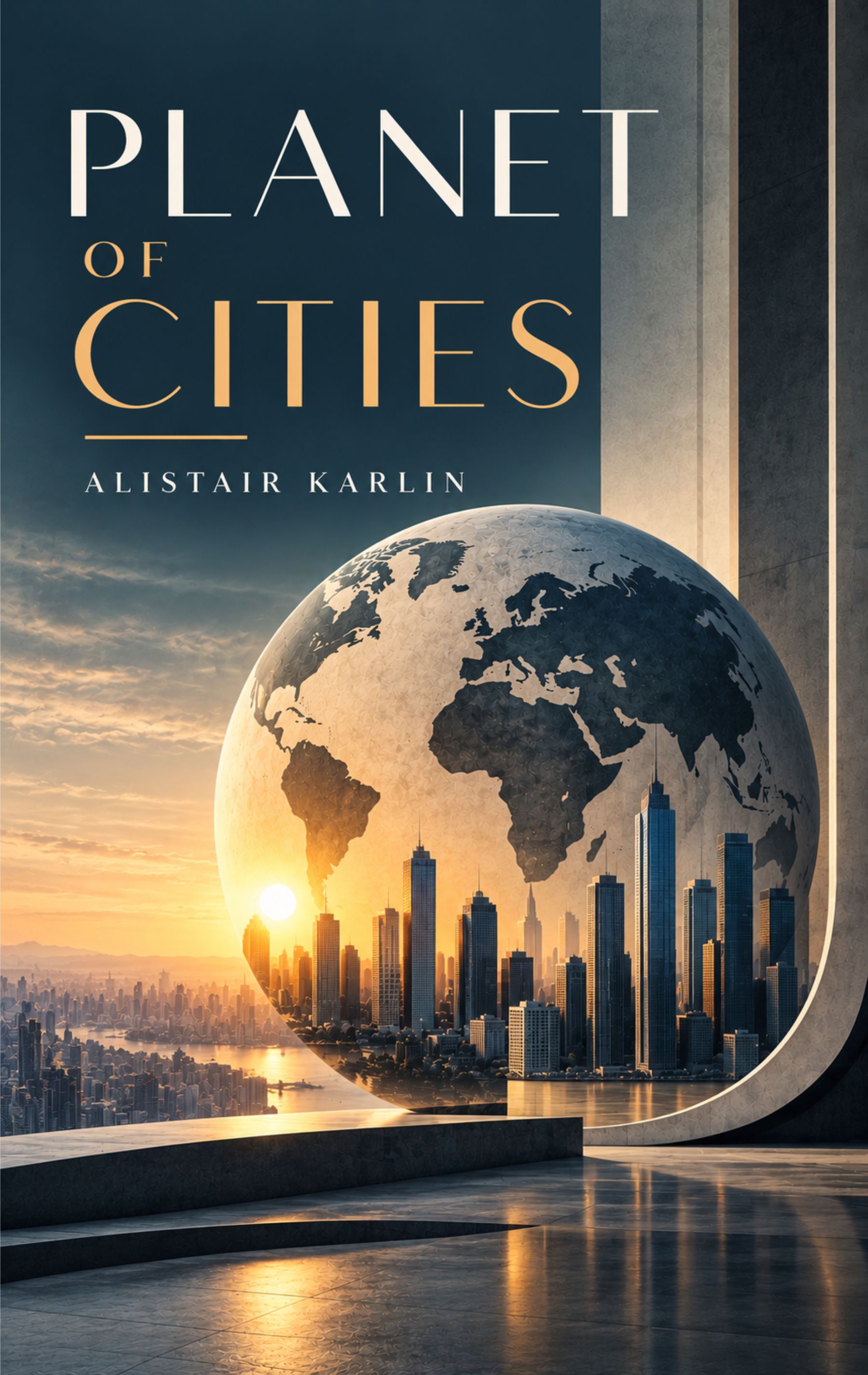
Planet of Cities is grounded in the expansive research of the Atlas of Urban Expansion, tracking how 120 globally representative cities change over time. It projects that while urban populations will swell, urban land footprints will multiply even faster, making proactive infrastructure planning essential for future economic health and environmental preservation. The book explores the future of metropolitan areas and questions the restrictive "containment paradigm" trying to stop cities from expanding and proposes a realistic "making room" approach that embraces and plans for inevitable urban growth. It analyzes global data regarding rural-to-urban migration, metropolitanization, and natural population increases, examining how rapid in-migration necessitates proactive, large-scale planning. It examines the role of cities as the engines of the global economy, exploring how urban agglomeration drives innovation, wealth, and global connectivity. Breaks down physical urban development, outlining the principles of density, securing land for public streets in advance, and establishing efficient, flexible spatial structures. Balances the environmental impacts of urban sprawl with sustainable development strategies, addressing the critical need for urban resilience in the face of climate change. Focuses on the logistical heartbeat of modern cities-highlighting how expanding urban land requires upfront securing of utility networks, transit lines, and broad connectivity. Discusses the institutional frameworks and policies required to manage sprawling metropolitan areas, emphasizing affordable housing and the flexible management of global growth. Planet of Cities is a useful book that redefines our understanding of global urbanization. It offers planners and decision-makers a data-driven science of cities and the practical, actionable agenda necessary to sustainably manage the unprecedented mass urban in-migration expected in the coming decades. The book is an essential resource for urban planners, policymakers, civic leaders, and academics who need a quantitative, reality-based foundation for managing the massive demographic shifts occurring globally.
Dr. Alistair Karlin is an urban sociologist, speculative geographer, and former advisor to the United Nations Human Settlements Programme. Born in Tokyo and raised across four continents, Karlin spent two decades studying the metabolic lifecycles of megacities, from the vertical density of Hong Kong to the sprawling networks of São Paulo. He holds a PhD in Comparative Urbanism from the London School of Economics, where his radical thesis on "sentient infrastructure" won the prestigious Howard Prize. Planet of Cities is the culmination of his life's research, merging data science, history, and sociology to project the future of our completely urbanized tomorrow. He lives in Chicago with his family and a very unruly collection of antique maps. Before turning to fiction and speculative non-fiction, he worked as a field researcher mapping informal settlements in Chicago suburbs and designing climate-resilient transit models for the Scandinavian Eco-Alliance. His academic papers frequently challenged traditional borders, arguing that humanity has already transitioned from a planet of nations to an interconnected global grid of concrete and glass. When he is not lecturing or consulting on smart-city design, he can be found exploring abandoned subway systems or documenting architectural anomalies for his popular photography archive.
| Preface Chapter 1. Understanding the Planet of Cities Cities as Drivers of Global Transformation Urbanization and Planetary Change Cities as Complex Adaptive Systems Historical Perspectives on Urban Growth Conceptualizing Global Urban Networks The City in the Anthropocene The Relationship between Cities and Nature Measuring Urban Impact on the Planet Chapter 2. The Demographics of Urbanization Global Urban Population Trends Rural-to-Urban Migration Patterns Growth of Mega-Cities and Metropolises Population Density and Urban Form Aging, Youth, and Urban Demographics Social and Economic Implications of Urban Growth Migration, Refugees, and Urban Inclusion Predicting Future Urban Populations Chapter 3. Urban Economy and Global Cities Cities as Engines of Economic Growth Global Cities and World Urban Networks Industrialization, Knowledge, and Innovation Employment Patterns and Urban Labor Markets Informal Economy and Livelihoods Real Estate, Finance, and Urban Investment Economic Inequality in Cities Policies for Sustainable Urban Economies Chapter 4. Urban Form, Design and Spatial Structure Morphology of Cities across the Planet Street Networks, Blocks, and Urban Patterns Land Use Planning and Zoning Public Spaces and Urban Commons Density, Scale, and Vertical Urbanism Waterfronts, Hills, and Geographic Constraints |
Chapter 5. Environment, Sustainability, and Climate Cities and Climate Change Green Infrastructure and Urban Ecosystems Energy, Water, and Resource Management Air Quality, Pollution, and Urban Health Climate-Resilient Urban Design Nature-Based Solutions in Cities Sustainable Transport and Mobility Chapter 6. Infrastructure, Technology and Connectivity Transport Networks and Mobility Systems Utilities and Urban Services Digital Infrastructure and Smart Cities Technology for Urban Management and Planning Data, AI, and Predictive Urban Analytics Public–Private Partnerships in Infrastructure Resilient and Adaptive Urban Systems Future Infrastructure Challenges Chapter 7. Governance, Policy and Urban Institutions Local, Regional, and Global Governance Urban Policy Frameworks and Planning Tools Participatory Governance and Civic Engagement Multi-Level Coordination and Collaboration Regulation, Zoning, and Legal Frameworks Bibliography Index |

$280.00