
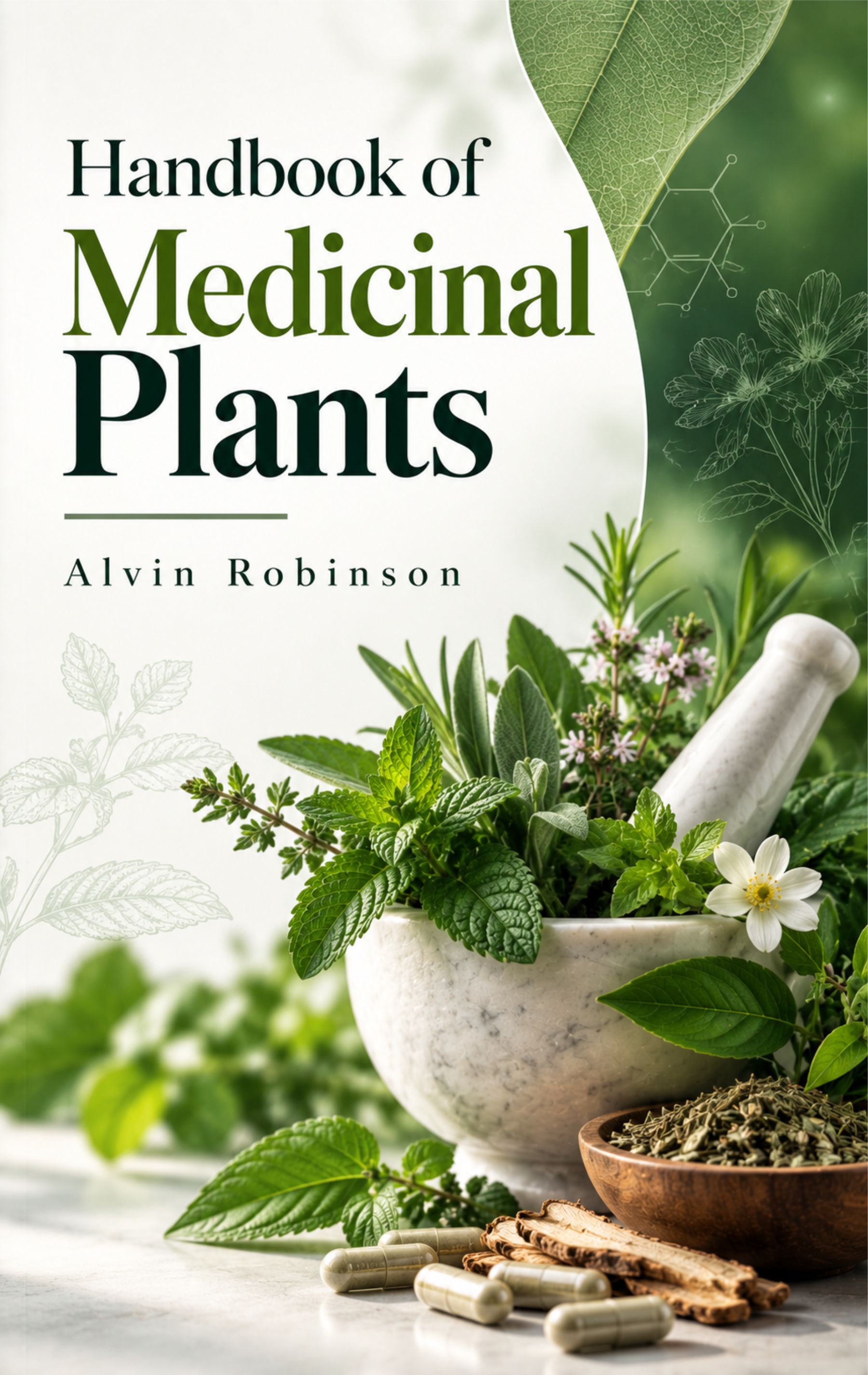
A comprehensive Handbook of Medicinal Plants integrates traditional ethnomedicinal wisdom with modern pharmacognosy, providing a vital framework for discovering, validating, and producing plant-derived therapeutics. It serves as a definitive guide for researchers, botanists, and pharmaceutical developers. Handbook of Medicinal Plants explores the historical timeline of herbal medicine, the World Health Organization (WHO) classifications, and the cultural relevance of traditional healing systems (e.g., Ayurveda, Unani, and Traditional Chinese Medicine) in contemporary healthcare. Details plant morphology, cellular structures, and the classification of floral families. It emphasizes accurate botanical identification and nomenclature to prevent species adulteration. Focuses on the isolation, structural characterization, and biochemical profiling of bioactive compounds like alkaloids, tannins, flavonoids, and glycosides that trigger beneficial biological activities. Discusses modern agro-technologies, including soil management, organic farming, seed germination, and vegetative propagation strategies for maximizing active biomolecule yields. Pharmacological Properties and Therapeutic Applications examines the clinical efficacy of herbal extracts. This covers anti-inflammatory, antimicrobial, and antioxidant properties, alongside detailed toxicity studies and potential interactions with synthetic drugs. Quality Control and Standardization addresses the analytical methods used to ensure drug consistency and safety. This involves chromatography (e.g., HPLC), spectroscopy, DNA barcoding, and testing for heavy metals or pesticide residues.
The scent of crushed eucalyptus and dried lavender always clung to Dr. Alvin Robinson, a man whose mind was a living archive of the natural world. Long before his seminal work, Handbook of Medicinal Plants, became a definitive guide for healers and botanists worldwide, Alvin was simply a curious boy, filling leather-bound notebooks with pressed leaves and ink sketches. His fascination began in his grandmother’s garden, but it matured in the dense, untamed rainforests of South America and the mist-shrouded valleys of the Himalayas. For four decades, Alvin lived a life divided between the raw wilderness and academic isolation. During his years in the tropics, he survived malaria after brewing a bitter tea from a rare bark, a remedy taught to him by an indigenous elder. That encounter taught him that traditional knowledge often held a depth of wisdom that could complement even the most advanced metropolitan laboratories. Writing Handbook of Medicinal Plants was a grueling labor of love that took fifteen years. Working by the dim light of a kerosene lamp in his study, surrounded by floor-to-ceiling shelves of glass jars, Alvin meticulously catalogued more than two thousand species. He insisted on drawing every root system and flower petal himself, believing that a photograph could never capture the vital essence of a plant in the same way as a dedicated hand. His fingertips were permanently stained a faint walnut brown from years of handling raw extracts and ink. When the book was finally published, Alvin chose not to attend the grand reception held in his honor by the Royal Botanical Society. Instead, on that very evening, the elderly author was miles away, walking through a quiet meadow with a canvas satchel over his shoulder. For Alvin, the true reward was not fame or accolades, but the simple knowledge that the silent, healing language of the earth had finally been given a voice.
| Preface Chapter 1. Introduction to Medicinal Plants Definition and Scope of Medicinal Plants Historical Development of Herbal Medicine Classification of Medicinal Plants Role of Medicinal Plants in Healthcare Systems Global Distribution of Medicinal Flora Importance of Phytotherapy Conservation Status of Medicinal Species Contemporary Relevance of Medicinal Plants Chapter 2. Botany and Taxonomy of Medicinal Plants Morphological Characteristics Anatomical Features Plant Identification Techniques Taxonomic Classification Systems Herbarium and Documentation Methods Nomenclature Rules and Standards Molecular Tools in Plant Identification Authentication of Herbal Raw Materials Chapter 3. Phytochemistry of Medicinal Plants Primary and Secondary Metabolites Alkaloids and Their Properties Glycosides and Therapeutic Uses Tannins and Phenolic Compounds Essential Oils and Volatile Constituents Flavonoids and Bioactive Compounds Extraction and Isolation Techniques Phytochemical Screening Methods Chapter 4. Cultivation and Propagation Techniques Site Selection and Climate Requirements Soil and Nutrient Management Seed Propagation Methods Vegetative Propagation Techniques Nursery Management Practices Organic Cultivation Methods Harvesting Techniques Post-Harvest Handling and Storage Chapter 5. Pharmacological Properties and Therapeutic Applications Mechanisms of Action of Herbal Drugs Anti-Inflammatory and Analgesic Plants Antimicrobial and Antiviral Plants Antioxidant and Immunomodulatory Plants Cardiovascular and Metabolic Applications Respiratory and Digestive System Uses Dermatological Applications Safety and Toxicological Considerations |
|

$280.00