
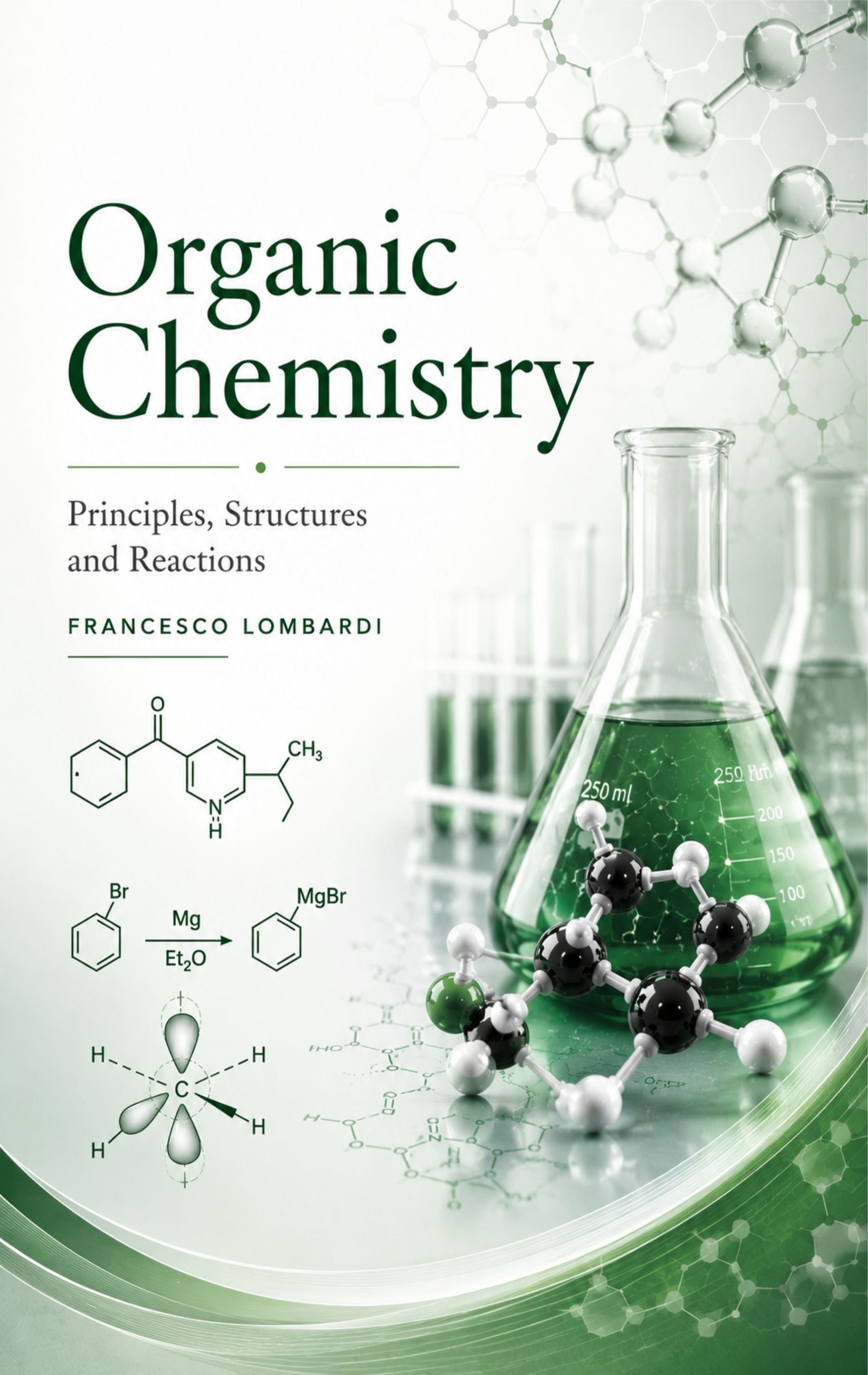
Organic chemistry studies the structure, properties and reactions of organic compounds, which contain carbon in covalent bonding. The study of structure determines their chemical composition and formula and the study of properties includes physical and chemical properties, and evaluation of chemical reactivity to understand their behavior. The study of organic reactions includes the chemical synthesis of natural products, drugs, and polymers, and study of individual organic molecules in the laboratory and via theoretical (in silico) study. Organic Chemistry serves as the definitive masterwork designed for advanced students, researchers, and industry professionals seeking an exhaustive and authoritative reference. This comprehensive text bridges the foundational principles of molecular structure with the cutting-edge breakthroughs driving modern chemical engineering, pharmacology, and material science. Engineered for clarity without sacrificing mathematical or mechanistic rigor, it stands as the ultimate anchor for any scientific library, transforming complex chemical theory into an actionable, highly scannable blueprint of the molecular world. The text is expansive and covers all areas of basic organic chemistry with some of the later chapters introducing topics such as biological pathways, intermediate-level organic reactions, and polymers.
Francesco Lombardi is a distinguished organic chemist and educator whose career spans over two decades of cutting-edge research and classroom excellence. He holds a Ph.D. in Organic Chemistry from the University of Bologna, followed by a prestigious postdoctoral fellowship at the Swiss Federal Institute of Technology (ETH Zürich), where he specialized in asymmetric synthesis and sustainable catalytic processes. Currently serving as a Full Professor of Chemistry, Dr. Lombardi has dedicated his career to demystifying the molecular world for generations of students. He has authored over 50 peer-reviewed research papers in high-impact journals and is a frequent keynote speaker at international chemical forums. Driven by the belief that organic chemistry is not a subject to be memorised, but a logical puzzle to be solved, Dr. Lombardi brings his signature clarity, passion, and real-world problem-solving approach to this textbook.
| Preface Chapter 1. Structure and Bonding in Organic Molecules Atomic Structure and Hybridization Covalent Bonding and Molecular Orbitals Functional Groups and Classification Resonance and Electron Delocalization Inductive and Mesomeric Effects Acid–Base Concepts in Organic Chemistry Intermolecular Forces Introduction to Organic Nomenclature Chapter 2. Stereochemistry and Conformational Analysis Isomerism: Structural and Stereoisomerism Chirality and Optical Activity R/S and E/Z Nomenclature Conformational Analysis of Alkanes Cycloalkane Conformations Stereochemical Outcomes of Reactions Diastereomers and Meso Compounds Applications of Stereochemistry in Synthesis Chapter 3. Reaction Mechanisms and Kinetics Fundamentals of Reaction Mechanisms Energy Profiles and Transition States Nucleophiles and Electrophiles Carbocations, Carbanions, and Radicals Substitution Reactions (SN1 and SN2) Elimination Reactions (E1 and E2) Rearrangement Reactions Principles of Chemical Kinetics Chapter 4. Alkanes and Cycloalkanes Structure and Properties of Alkanes Sources and Industrial Importance Free Radical Halogenation Combustion and Environmental Impact Conformations of Cycloalkanes Strain and Stability Physical Properties and Applications Synthesis of Alkanes Chapter 5. Alkenes and Alkynes Structure and Bonding in Alkenes Electrophilic Addition Reactions Markovnikov and Anti-Markovnikov Additions Oxidation and Reduction of Alkenes Structure and Properties of Alkynes Addition Reactions of Alkynes Polymerization Reactions Industrial and Synthetic Applications |
|

$280.00