
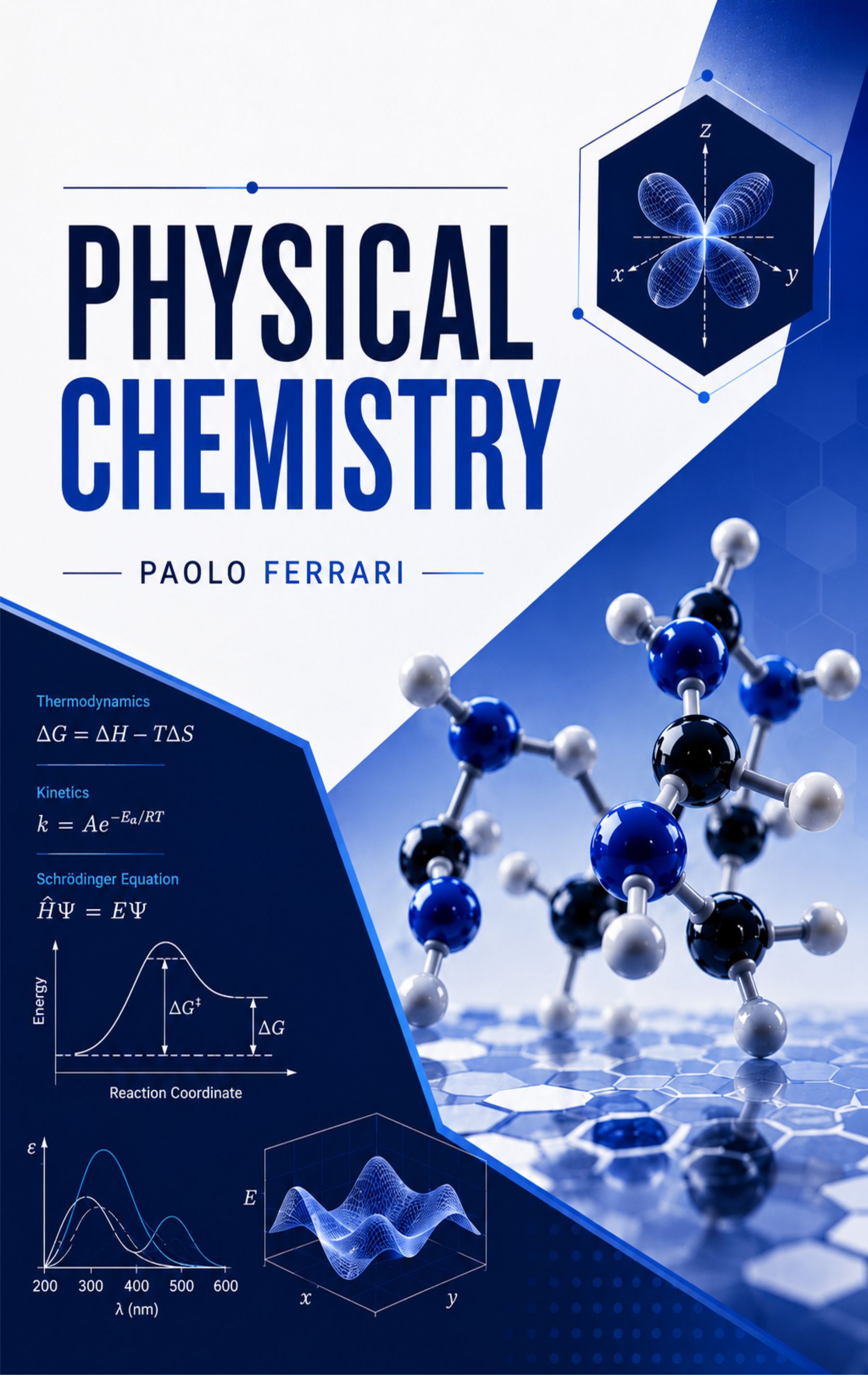
Unlocking the mysteries of the molecular world requires more than just memorising equations; it demands a deep, intuitive understanding of the forces that drive chemical reactions. Physical Chemistry bridges the gap between abstract mathematical theory and tangible chemical phenomena, providing students and educators with a definitive, highly accessible guide to the core principles of the discipline. Designed with clarity and academic rigor at its heart, this comprehensive book deconstructs complex topics such as quantum mechanics, thermodynamics, chemical kinetics, and statistical mechanics. Instead of presenting equations in isolation, the book contextualises every mathematical derivation with real-world applications, from atmospheric chemistry to cutting-edge nanotechnology and biophysical systems. This conceptual framework helps learners develop the critical problem-solving skills necessary to tackle even the most daunting examinations and research challenges
Paolo Ferrari is a distinguished educator and researcher specializing in molecular dynamics, chemical thermodynamics, and quantum chemistry. He holds a Ph.D. in Physical Chemistry; his pioneering research focused on bridging classical thermodynamic principles with modern computational modeling. With over two decades of experience in both academia and industry, Dr. Ferrari has dedicated his career to demystifying the complex mathematical and physical frameworks that govern chemical systems. As a tenured professor, he has received multiple teaching excellence awards for his ability to translate abstract quantum mechanics and statistical mechanics into accessible, engaging concepts for students. His extensive list of peer-reviewed publications and active contributions to international chemistry journals refiect his deep commitment to advancing the field. In Physical Chemistry, Dr. Ferrari combines his rigorous academic expertise with his passionate teaching philosophy to deliver a definitive, clear, and comprehensive guide tailored for the next generation of scientists.
| Preface Chapter 1. Foundations of Physical Chemistry Scope and Historical Development Mathematical Tools for Physical Chemistry Units, Dimensions, and Measurement Systems States of Matter and Molecular Interactions Energy, Work, and Heat Laws of Chemical Combination Microscopic and Macroscopic Descriptions Applications in Modern Science and Engineering Chapter 2. Classical Thermodynamics The First Law of Thermodynamics Enthalpy and Thermochemistry The Second Law of Thermodynamics Entropy and Spontaneity The Third Law of Thermodynamics Gibbs and Helmholtz Free Energies Thermodynamic Potentials and Maxwell Relations Applications to Chemical Systems Chapter 3. Chemical Equilibrium Law of Mass Action Equilibrium Constant and Reaction Quotient Le Chatelier’s Principle Temperature and Pressure Effects Equilibria in Ideal and Non-Ideal Systems Phase Equilibria and Phase Diagrams Colligative Properties Applications in Industrial Chemistry Chapter 4. Chemical Kinetics Rate Laws and Reaction Order Integrated Rate Equations Temperature Dependence and Arrhenius Equation Reaction Mechanisms Catalysis and Enzyme Kinetics Collision and Transition State Theories Chain and Photochemical Reactions Experimental Methods in Kinetics Chapter 5. Quantum Chemistry Wave–Particle Duality Schrödinger Equation Particle in a Box Model Quantum Harmonic Oscillator Hydrogen Atom Solutions Molecular Orbital Theory Approximation Methods Applications in Spectroscopy and Bonding |
|

$280.00