
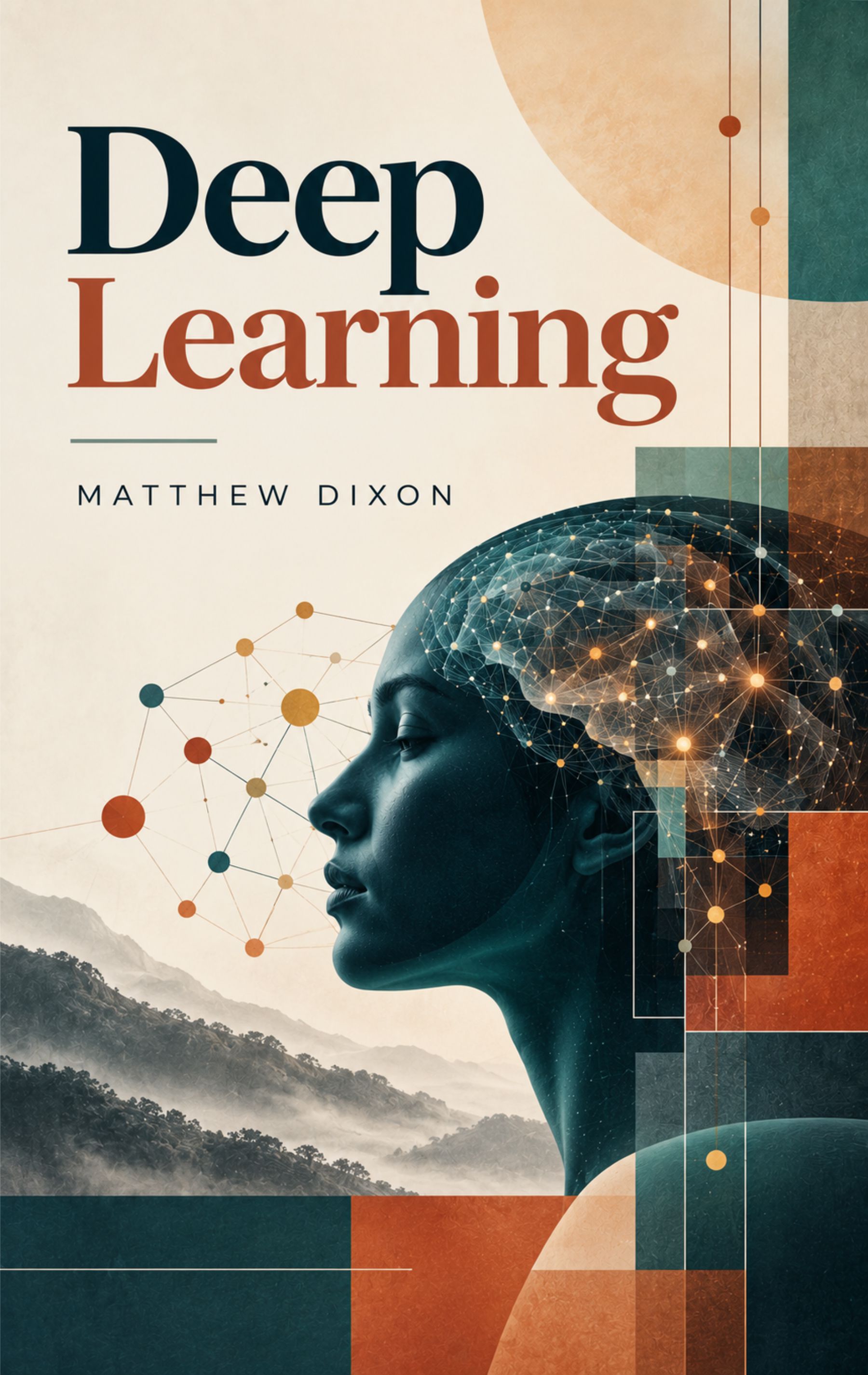
Deep learning is a form of machine learning that enables computers to learn from experience and understand the world in terms of a hierarchy of concepts. Because the computer gathers knowledge from experience, there is no need for a human computer operator formally to specify all of the knowledge needed by the computer. The hierarchy of concepts allows the computer to learn complicated concepts by building them out of simpler ones; a graph of these hierarchies would be many layers deep. This book introduces a broad range of topics in relation to deep learning. The text offers a mathematical and conceptual background covering relevant concepts in linear algebra, probability theory and information theory, numerical computation, and machine learning. It describes deep learning techniques which are used by practitioners in industry, including deep feedforward networks, regularization, optimization algorithms, convolutional networks, sequence modeling, and practical methodology; and it surveys such applications as natural language processing, speech recognition, computer vision, online recommendation systems, bioinformatics, and videogames. Deep learning can be used by undergraduate or graduate students who are planning careers in either industry or research, and by software engineers who want to begin using deep learning in their products or platforms. This book provides a great way to start off with deep learning, with plenty of examples and well-explained concepts. A perfect book for readers of all levels who are interested in the domain.
Matthew Dixon is a visionary computer scientist, researcher, and author whose authoritative work at the intersection of mathematical finance, advanced computing, and artificial intelligence has fundamentally shaped modern neural network deployment. Armed with a Ph.D. in Applied Mathematics from the Imperial College London and years of post-doctoral research at Stanford University, Dixon bridges the gap between abstract statistical theory and high-performance algorithmic execution. His seminal textbook, Deep Learning, stands as a definitive masterwork in the field, celebrated for its rigorous mathematical foundations and its uncompromisingly practical approach to building scalable, intelligent systems. As a leading academic and a sought-after consultant for Silicon Valley’s elite tech firms, Dixon brings decades of frontline experience in training deep neural architectures. His deep expertise spans recurrent neural networks (RNNs), convolutional frameworks, and generative AI models, making his writing uniquely authoritative. In Deep Learning, Dixon leverages his extensive qualification to demystify complex concepts—such as stochastic gradient descent, backpropagation mechanics, and high-dimensional data topologies—translating them into intuitive, actionable insights for engineers and researchers alike. His rare capability to blend profound academic rigor with real-world engineering constraints positions him not just as an educator, but as a definitive architect of the AI revolution.
Preface Chapter 1. Introduction to Deep Learning Evolution of Artificial Intelligence and Deep Learning Foundations of Neural Networks Deep Learning vs Traditional Machine Learning Mathematical Prerequisites for Deep Learning Learning Paradigms and Architectures Computational Requirements and Frameworks Applications of Deep Learning Ethical and Societal Implications Chapter 2. Neural Network Fundamentals Artificial Neurons and Activation Functions Single-Layer and Multi-Layer Networks Loss Functions and Optimization Objectives Gradient Descent and Variants Backpropagation Algorithm Weight Initialization Strategies Model Capacity and Generalization Common Challenges in Training Chapter 3. Optimization and Regularization Techniques Optimization Challenges in Deep Networks Stochastic Gradient Descent Adaptive Optimization Algorithms Learning Rate Scheduling Regularization Methods Dropout and Batch Normalization Preventing Overfitting Hyperparameter Tuning Chapter 4. Convolutional Neural Networks Motivation and Biological Inspiration Convolution and Pooling Operations CNN Architectures Image Classification and Recognition Object Detection Techniques Semantic Segmentation Transfer Learning with CNNs Performance Evaluation Chapter 5. Recurrent and Sequence Models Sequential Data and Temporal Modeling Recurrent Neural Networks Long Short-Term Memory Networks Gated Recurrent Units Sequence-to-Sequence Models Attention Mechanisms Applications in Time-Series and NLP Training Challenges in RNNs Chapter 6. Transformer Models and Large-Scale Learning Motivation for Transformer Architectures Self-Attention Mechanism Transformer Encoder–Decoder Models Pretrained Language Models Scaling Laws and Model Efficiency Fine-Tuning and Prompt-Based Learning Multimodal Transformers Limitations and Challenges Chapter 7. Unsupervised and Generative Deep Learning Autoencoders and Variational Autoencoders Deep Clustering Techniques Generative Adversarial Networks Training Stability in GANs Energy-Based Models Diffusion Models Representation Learning Applications of Generative Models Chapter 8. Deep Learning for Specialized Domains Deep Learning in Computer Vision Natural Language Processing Applications Speech and Audio Processing Reinforcement Learning with Deep Networks Deep Learning in Healthcare Scientific and Engineering Applications Edge and Embedded Deep Learning Case Studies Chapter 9. Model Deployment, Evaluation, and Ethics Model Evaluation Metrics Interpretability and Explainability Model Compression and Acceleration Deployment Pipelines Monitoring and Maintenance Robustness and Security Bias and Fairness in Deep Learning Responsible AI Practices Chapter 10. Emerging Trends and Future Directions in Deep Learning Self-Supervised Learning Foundation Models Neural Architecture Search Federated and Distributed Learning Quantum and Neuromorphic Computing Green and Sustainable Deep Lea

$280.00