
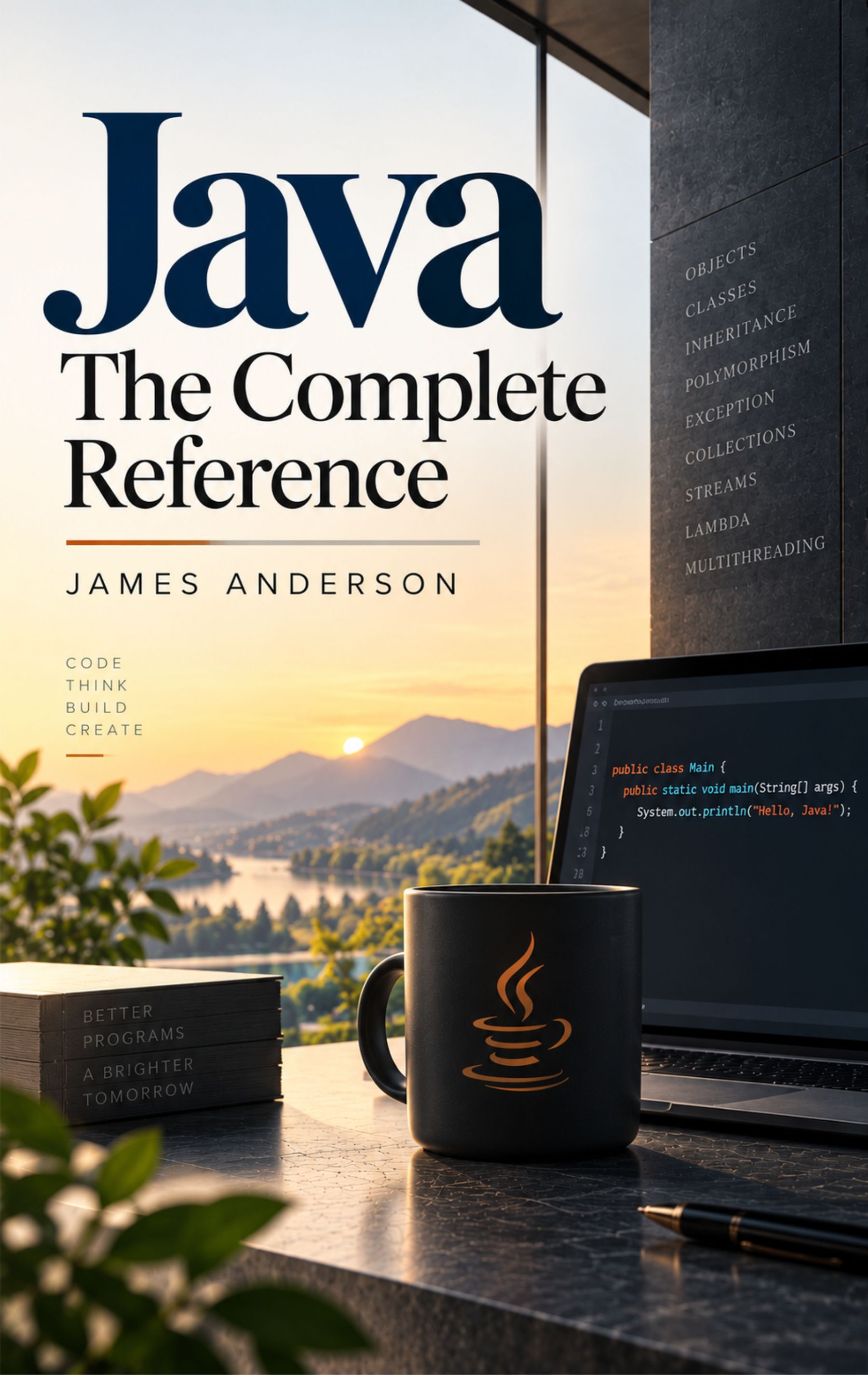
Java is one of the world’s most important and widely used computer languages. Furthermore, it has held that distinction for many years. Unlike some other computer languages whose influence has waned with the passage of time, Java’s has grown stronger. Java leapt to the forefront of Internet programming with its first release. Each subsequent version has solidified that position. Today, it is still the first and best choice for developing web-based applications. It is also a powerful, general-purpose programming language suitable for a wide variety of purposes. Simply put: much of the modern world runs on Java code. Java really is that important. This comprehensive guide shows, step by step, how to design, write, debug, run, and administer high-performance Java programs. It covers the entire Java language, including its syntax, keywords, and libraries. The book lays out cutting-edge development techniques and best practices. Java: The Complete Reference features clear explanations, detailed code samples, and real-world examples that demonstrate how Java can be put to work in the real world. JavaBeans, servlets, applets, Swing, lambda expressions, multithreading, and the default interface method are thoroughly discussed. The book provides a masterful treatment of multithreading, lambda expressions, default interface methods, and cutting-edge features like virtual threads and the modular system introduced in recent JDK releases. Written in a crisp, sharp, and authoritative voice, it cuts through technical abstraction by pairing every single concept with clean, executable, real-world code samples.
James Anderson is a distinguished computer scientist, veteran software architect, and educator who has spent over two and a half decades shaping the landscape of enterprise software development. Known for his uncanny ability to demystify complex systems, Anderson has bridged the gap between academic computer science theory and real-world industrial application, making him one of the most respected voices in the global programming community. He holds a Master of Science (M.S.) in Computer Science from the Massachusetts Institute of Technology (MIT), focusing on distributed systems and compiler design. Anderson spent over twelve years as a Principal Software Architect at leading Silicon Valley firms, where he spearheaded the migration of legacy banking infrastructures to highly secure, concurrent Java environments. As an adjunct professor of software engineering, he has spent years refining how object-oriented programming is taught, helping thousands of students transition from syntax novices to architecture masters. A long-time participant in the Java Community Process (JCP), Anderson has actively contributed to the evolution of the language, particularly in the realms of concurrency utilities and memory management optimizations. Anderson’s daily immersion in massive codebases and his deep pedagogical insights allow him to write with unmatched authority. He doesn't simply explain how a keyword works; he explains why it was engineered that way, how it behaves under heavy enterprise loads, and how to avoid the subtle architectural pitfalls that trap even experienced developers.
| Preface Chapter 1. Introduction to Java History and Evolution of Java Features and Advantages of Java Java Virtual Machine (JVM) and Architecture Java Editions: SE, EE, ME Java Development Environment Setup Compilation and Execution Process Writing Your First Java Program Understanding Java Applications Chapter 2. Java Fundamentals Java Syntax and Structure Data Types, Variables, and Constants Operators and Expressions Control Flow Statements (if, switch, loops) Arrays and Strings Input and Output Basics Type Casting and Conversion Exception Handling Fundamentals Chapter 3. Object-Oriented Programming in Java Classes and Objects Constructors and Destructors Methods and Method Overloading Encapsulation and Access Modifiers Inheritance and Types of Inheritance Polymorphism (Compile-Time and Run-Time) Abstraction and Abstract Classes Interfaces in Java Chapter 4. Packages and Java API Introduction to Packages Importing and Using Packages Java Standard Library Overview Utility Classes (java.util) I/O Packages (java.io, java.nio) Networking Packages (java.net) Date, Time, and Calendar Classes Best Practices for Package Management Chapter 5. Exception Handling and Multithreading Types of Exceptions Try, Catch, and Finally Blocks Throw and Throws Keywords Custom Exception Classes Introduction to Multithreading Thread Lifecycle and Thread Class Synchronization and Concurrency Thread Communication Techniques |
|

$280.00