
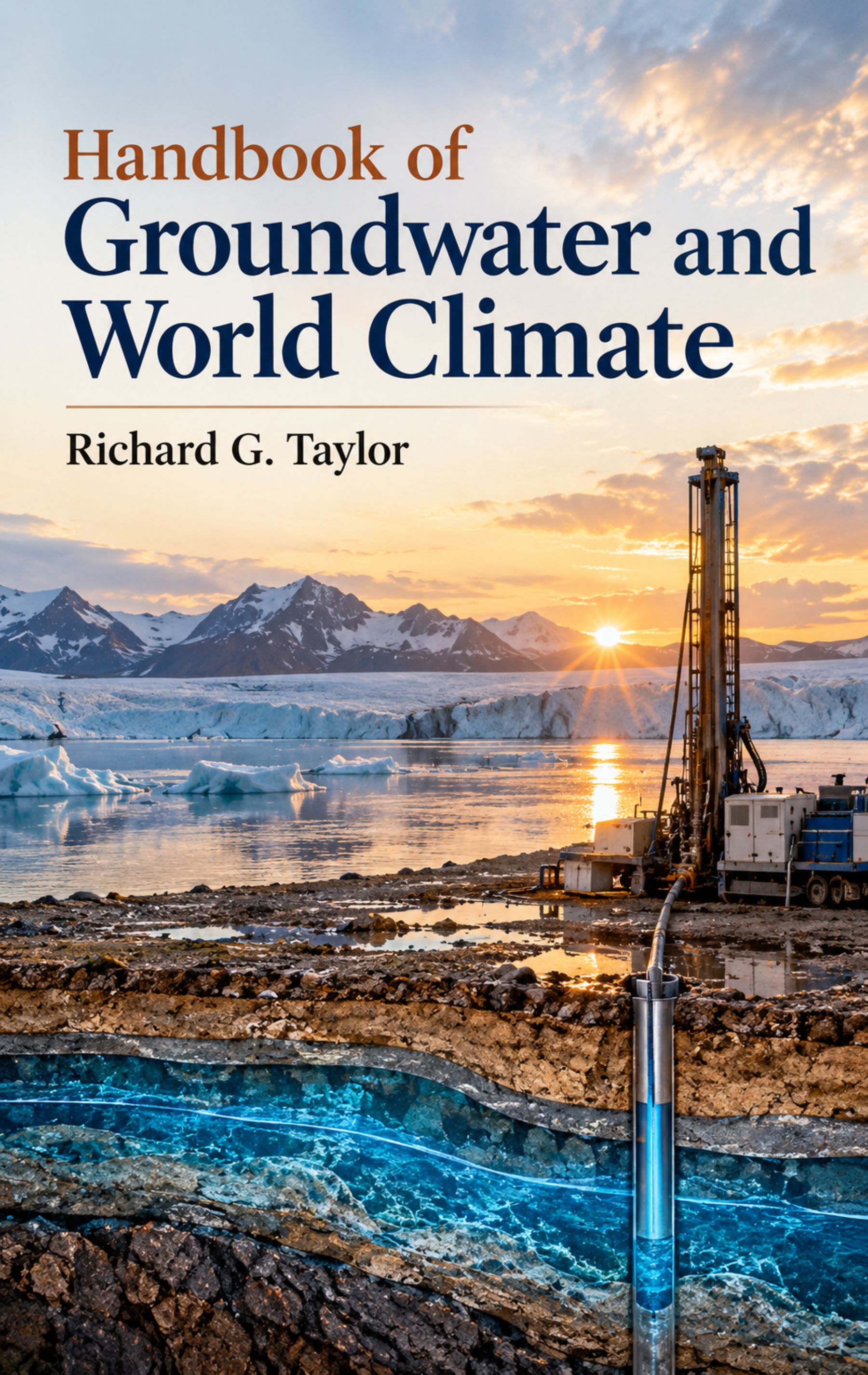
Handbook of Groundwater and World Climate serves as a definitive, forward-looking scientific masterwork operating at the crucial nexus of hydrogeology, meteorology, and climate change science. As our planet faces unprecedented shifts in climate patterns, this comprehensive handbook provides an authoritative blueprint for understanding, modeling, and safeguarding Earth’s most vital and heavily extracted hidden asset: sub-surface water. Far from being a dry compilation of static equations, the book is a dynamic, multi-disciplinary call to action that bridges fundamental fluid physics with global climate projections. The Handbook of Groundwater and World Climate fundamentally shifts this paradigm. It illuminates the intricate feedback loop between the atmosphere and subsurface aquifers. The volume exposes how intensifying global phenomena—such as shifting precipitation regimes, accelerated snowmelt, rising sea levels, and prolonged droughts—directly alter natural aquifer recharge rates and induce severe coastal saltwater intrusion. The Handbook of Groundwater and World Climate proves that groundwater management is no longer just a local engineering challenge—it is a cornerstone of geopolitical stability and ecological survival. By weaving together atmospheric realities with underground mechanics, this text arms the next generation of geohydrologists, policy architects, and environmental engineers with the empirical weapons they need to defend the planet's most critical life-support system.
Dr. Richard G. Taylor holds a Ph.D. in Hydrogeology from the University of Toronto and currently serves as a Professor of Hydrogeology at University College London (UCL). His academic career is distinguished by a profound commitment to unearthing the hidden dynamics of subterranean water systems. His seminal research has fundamentally reshaped how the scientific community views the resilience and vulnerability of groundwater in the face of escalating climate extremes. Throughout his career, Dr. Taylor has led groundbreaking international research initiatives across Africa, Asia, and the Americas. He is widely recognized for co-founding the Chronology of Groundwater Recharge in Africa (Chronos) project and leading the GroFutures (Groundwater Futures in Sub-Saharan Africa) program. His field-based insights have provided the global scientific community with definitive empirical evidence on how heavy rainfall events—intensified by climate change—serve as critical mechanisms for replenishing deep aquifers. An author of over 150 peer-reviewed journal articles in prestigious publications such as Nature, Nature Climate Change, and Water Resources Research, Dr. Taylor is a highly cited scholar whose work bridges the gap between physical science and sustainable development. He frequently serves as an expert consultant and contributing author to major international climate bodies, including the Intergovernmental Panel on Climate Change (IPCC) and various United Nations water security initiatives. In Handbook of Groundwater and World Climate, Dr. Taylor synthesizes his extensive academic expertise, decades of rigorous field data, and passionate advocacy for climate adaptation. This definitive volume reflects his lifelong dedication to equipping scientists, policymakers, and resource managers with the critical tools required to sustain global water security in an era of unprecedented environmental change.
Preface 1.GROUNDWATER: THE BIG PICTURE 1.1 Introduction 1.2 Global Water Reservoirs And Fluxes 1.3 Terminology For Subsurface Waters 1.4 Fluxes Affecting Groundwater 1.5 Hydrologic Balance 1.6 Water And Groundwater Use 1.7 What Groundwater Scientists Do 2.PHYSICAL PROPERTIES 2.1 Introduction 2.2 Properties Of Water 2.3 Properties Of Air 2.4 Properties Of Porous Media 2.5 Energy And Hydraulic Head 2.6 Measuring Hydraulic Head With Wells And Piezometers 3.PRINCIPLES OF FLOW 3.1 Introduction 3.2 Darcy’s Law And Hydraulic Conductivity 3.3 Intrinsic Permeability And Conductivity Of Other Fluids 3.4 Limits On The Application Of Darcy’s Law 3.5 Heterogeneity And Anisotropy Of Hydraulic Conductivity 3.6 Estimating Average Hydraulic Conductivities 3.7 Transmissivity 3.8 Measuring Hydraulic Conductivity 3.9 Flow In Fractured Rock 3.10 Unsaturated Flow 3.11 low Of Groundwater With Variable Density 4.PRINCIPLES OF FLOW 4.1 Introduction 4.2 Exploring The Subsurface 4.3 General Patterns Of Groundwater Flow 4.4 Groundwater In Unconsolidated Deposits 4.5 Groundwater In Sedimentary Rocks 4.6 Groundwater In Igneous And Metamorphic Rocks 4.7 Frozen Ground And Permafrost 5.DEFORMATION, STORAGE, AND GENERAL FLOW EQUATIONS 5.1 Introduction 5.2 Effective Stress 5.3 Atmospheric Pressure Fluctuations 5.4 Excavation Instability And Liquefaction 5.5 Slope Instability 5.6 Earthquakes And Groundwater Pressures 5.7 Matrix Compression 5.8 Changes In Subsurface Water Storage 5.9 General Flow Equations 5.10 verview Of Mathematical Modeling 6.MODELING STEADY FLOW WITH BASIC METHODS 6.1 Introduction 6.2 Aquifers With Uniform Transmissivity 6.3 Vertical Plane Flow 6.4 Flow Net Graphical Solutions 7.MODELING TRANSIENT FLOW WITH BASIC METHODS 7.1 Introduction 7.2 Radial Flow In Aquifers With Uniform Trans Missivity 7.3 Pumping Test Analysis 7.4 Additional Considerations For Pumping Tests 8.COMPUTER-ASSISTED FLOW MODELING 8.1 Introduction 8.2 Finite Difference Method 8.3 Finite Element Method 9.GROUNDWATER CHEMISTRY 9.1 Introduction 9.2 Molecular Properties Of Water 9.3 Solute Concentration Units 9.4 Natural Solutes 9.5 Chemical Reactions 9.6 Mineral Dissolution And Precipitation 9.7 Gas–Water Partitioning 10.GROUNDWATER CONTAMINATION 10.1 Introduction 10.2 Contamination Sources 10.3 Organic Contaminants 10.4 Nonaqueous-Phase Liquids Bibliography Index

$280.00